About
My idea for a 3D web app project came from my pre-existing original
characters, for which I have produced digital artwork in the past, as a
hobby. I have had an interest in learning 3D modelling for fun for
several years, so I struck upon the idea of modelling three of my OCs,
and creating a showcase for these.
3D Models
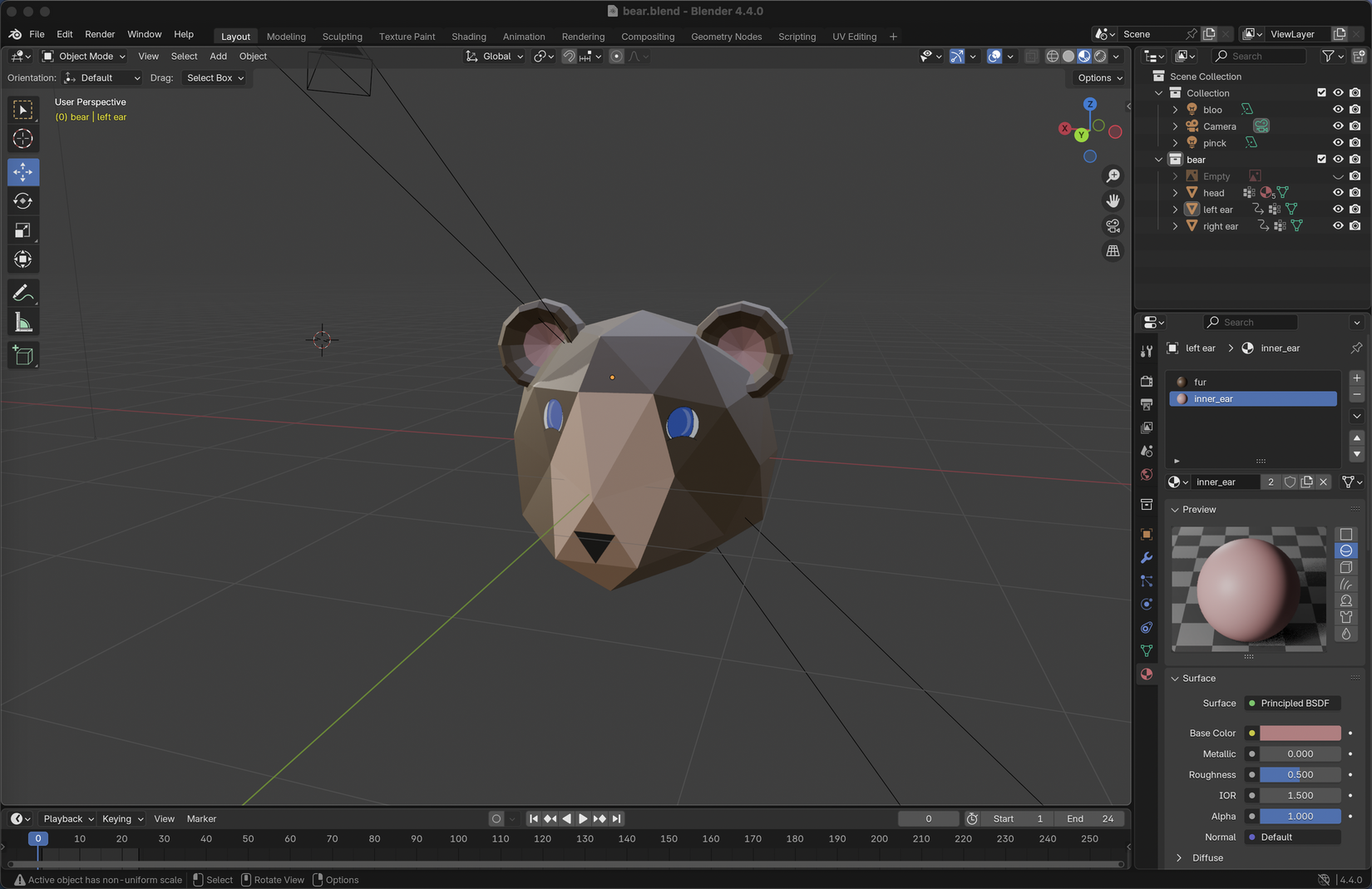
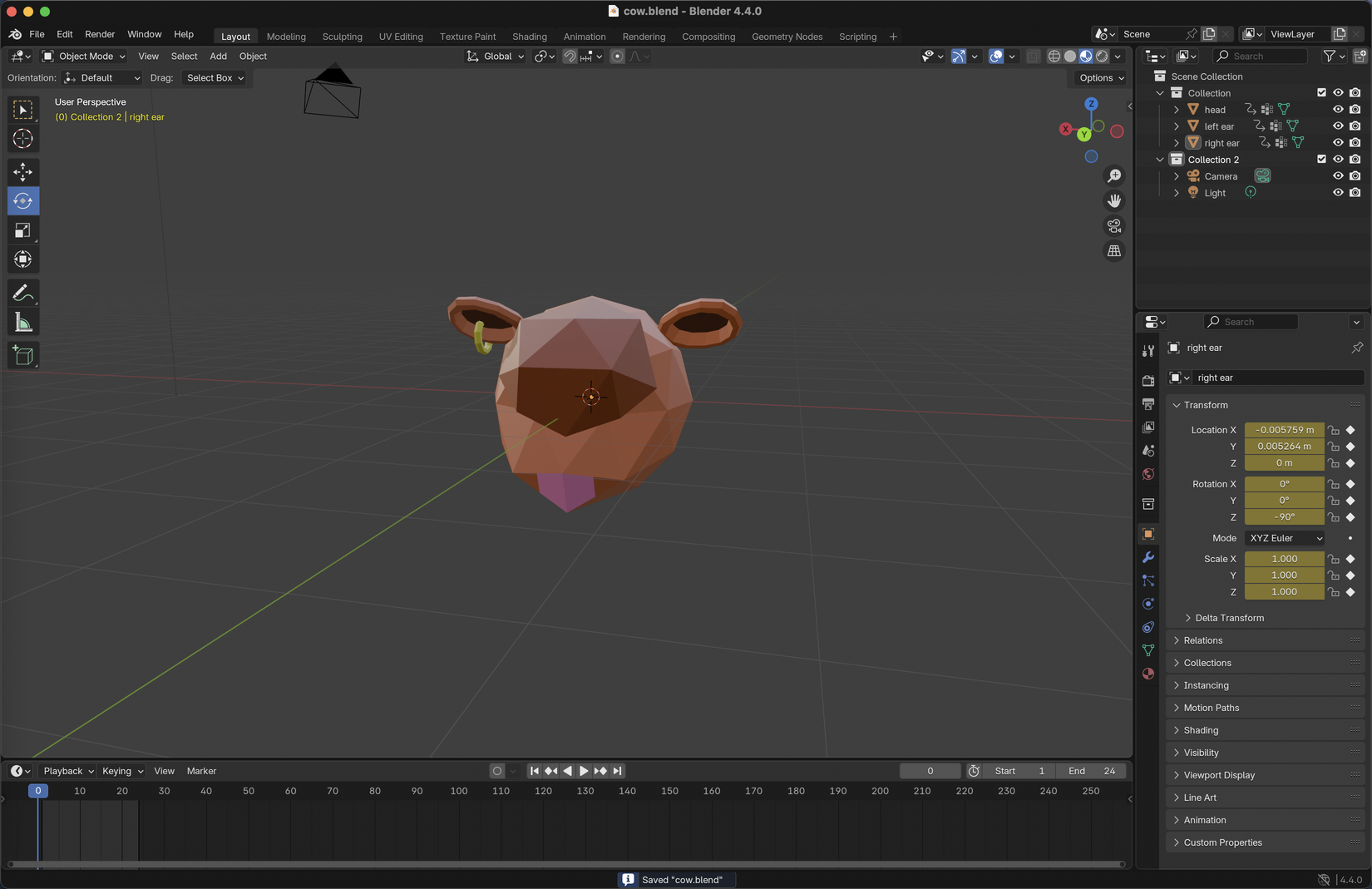
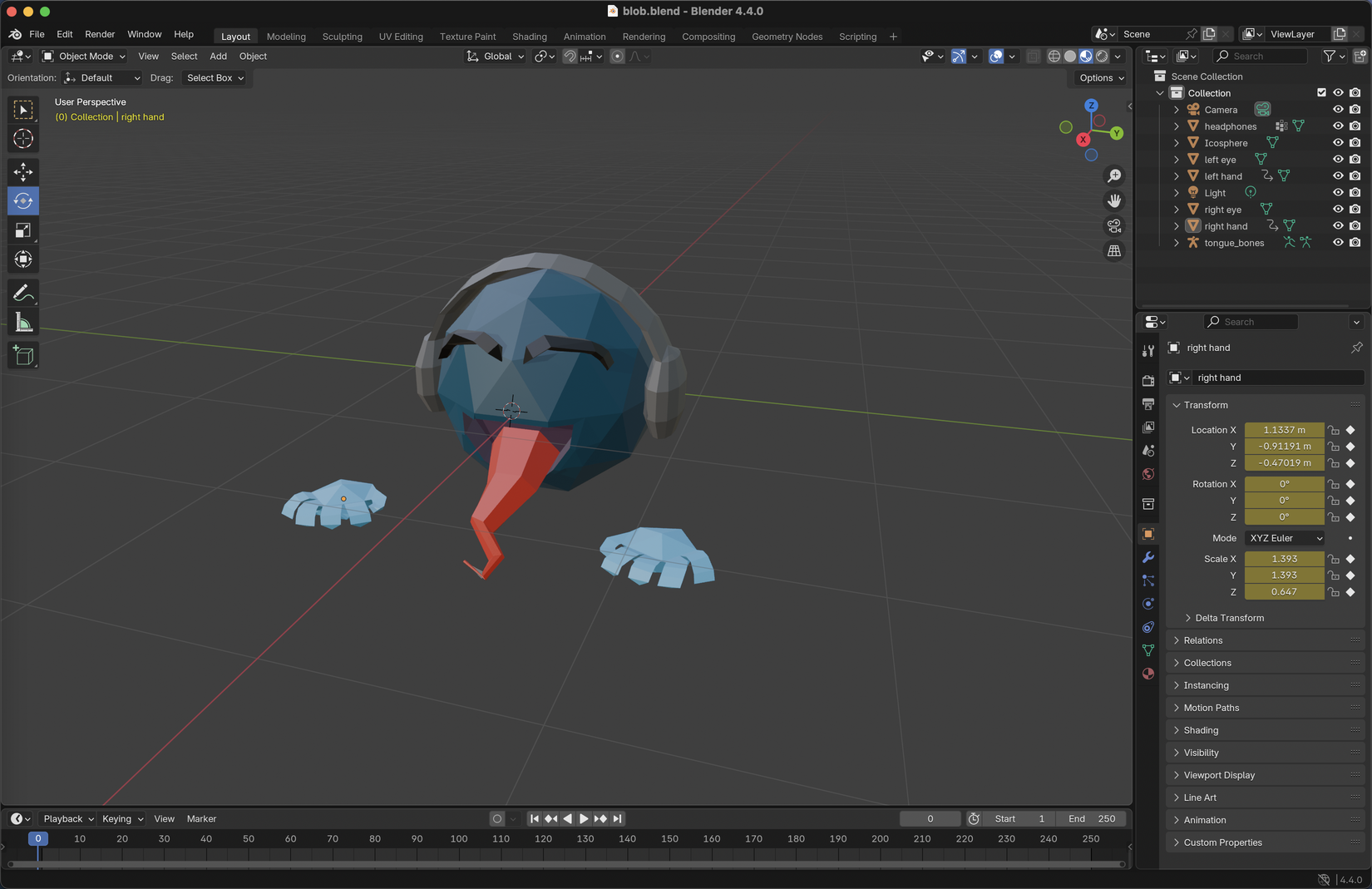
I produced nine 3D models in total: one for each character, then a
further two each, which were copies of the same respective base model
with a different animation.
Models and animations were produced in Blender, and the latter consisted
of both keyframes and bone manipulation. Each 3D model was deliberately
made with a low polygon count, allowing for a distinctive style without
being too overwhelming to develop or load.
The first model's eyes were created by hand-drawing left and right blue
eyes, keeping the low-poly style consistent by drawing this in a
low-resolution and pixelated canvas, before mapping the textures onto
the relevant faces of the model.
For all of the models, the colours were implemented using vertex groups
and Blender's standard material creation tool. I ensured these colour
choices, as well as my custom textures described above, were
consistently clear and visible through my use of lighting. This involved
constructing a DirectionalLight object in three.js, before attaching
this object to the camera, rather than the scene. A
HemisphereLight is also present in the scene, for some extra colour
balancing. No matter the angle the models are viewed, their features are
as visible as possible, without the lighting being so bright that the
colours are distorted.
During development, there were a multitude of problems relating to
exporting the animations. Firstly, the second animation I made for the
second character used shape keys in a way that three.js simply refused
to load, leading to that animation needing to be remade from scratch
without shape keys.
A previous attempt to implement the 3D models took an immense amount of
work and involved major refactors of almost all the three.js code
managing the loading of animations, but all of this had to be scrapped
when an issue arose that caused animations to be loaded and played on
the wrong models, since some versions of the character models had
separated meshes, whereas other meshes were unified. A much simpler
solution was thankfully found, and is elaborated on further down this
page.
For the third and final character, an animation involving the movement
of his tongue took considerable effort to make, as Blender's system of
bone rigging and weight painting had to be learned from scratch before
the animation could even be keyed. Once keyed, however, the animation
worked surprisingly well.
In addition, once the current method of loading the models was found to
be workable, each of the models had to be re-exported so they all faced
the same direction when loaded. In many cases, this meant deleting and
redoing the keyframes for each animation, from scratch. This, sadly,
couldn't feasibly be done with the animations for the final character,
since he has multiple separate meshes for each of his models.
Design
This site has been designed with a unique, yet simple and easy-to-use
interface. The home page contains three links to three separate
carousels of web pages wherein the model and animations of each
character can be observed. The canvas containing the 3D models in each
of these web pages, enabled with three.js, takes up the entire web page,
and navigational buttons are overlayed onto the canvas. CSS hover rules
were used for all of these buttons to conditionally highlight text and
make the design more responsive.
Integration
I conducted user testing for this project by using a friend's Windows
laptop to download the project directory from its GitHub page, then
hosting the directory using XAMPP. All models, lighting, colours,
styling, and animations worked flawlessly.
Quotes from friend: "Everything worked", "I liked it a lot!"
My friend also had feedback regarding having customisable lighting
options, such as toggles for switching between a point light and a
hemisphere light.
I conducted further user testing with another colleague, who offered
feedback regarding styling for the front page. Refactoring of the CSS
styling for the project was necessary to respond to this feedback, and
this spurred me to add further transformation styling for hyperlinks as
well as images.
As a result of this piece of feedback, not only was the padding of the
buttons on the homepage enlarged slightly, but now all links and buttons
are simultaneously highlighted and temporarily grow in size when hovered
over with a cursor.
Interaction
This website offers orbital controls and interactive buttons on each
model, allowing visitors to trigger three different animations on each
character. The animations were designed to be amusing and engaging, and
to fit well with the art style used for the characters. Each model also
has an option for visitors to toggle a wireframe view of it with the
click of a different button, giving a deeper insight into the
construction of each model.
Implementation
During development, I received feedback on the lighting used for each
model showcase, namely, that the models were not sufficiently visible
from certain angles. I fixed this by adding a light source at the same
point in 3D space as the camera.
This website will be deployed and available on my personal web domain at
https://threedee.cr0wbar.dev.
Deeper understanding
This project was developed and deployed as a PHP website, and Blender
was learned from scratch in order to create each model. It has also been
deployed on my own personal web domain, with Caddy being used for web
server hosting, rather than Apache or Nginx.
I also refrained from using Bootstrap, despite it being recommended, as
I have much more experience in vanilla CSS and am more confident in
making my own styling rules, rather than relying on a new, unfamiliar
library to handle this for me.
Version control is also being used for the project, and evidence of this
is available at
https://github.com/0cr0wbar0/threedee. Changes are committed, then pushed to the repository on GitHub, then
the most recent changes are pulled to my web server.
Prior to undertaking this project, I had very little experience with
JavaScript, and none at all with three.js, and this project has given me
bountiful experience with both.
I made use of CSS media queries on this page to ensure that the three
images displayed above are appropriately visible on a vertical or mobile
viewport, and used flexboxes to achieve the same for the text content. I
also added a transform function to CSS that causes each image to
temporarily increase in size with a smooth animation when hovered over
with a cursor.
About Us
✓ I have included at least three models
✓ I am not submitting brands of any kind
✓ I have created a user interface to interact with my models
✓ I have tested my site with user testing
✓ I have submitted both a link to the live version and a zipped
directory
✓ I have used this about page to provide development information